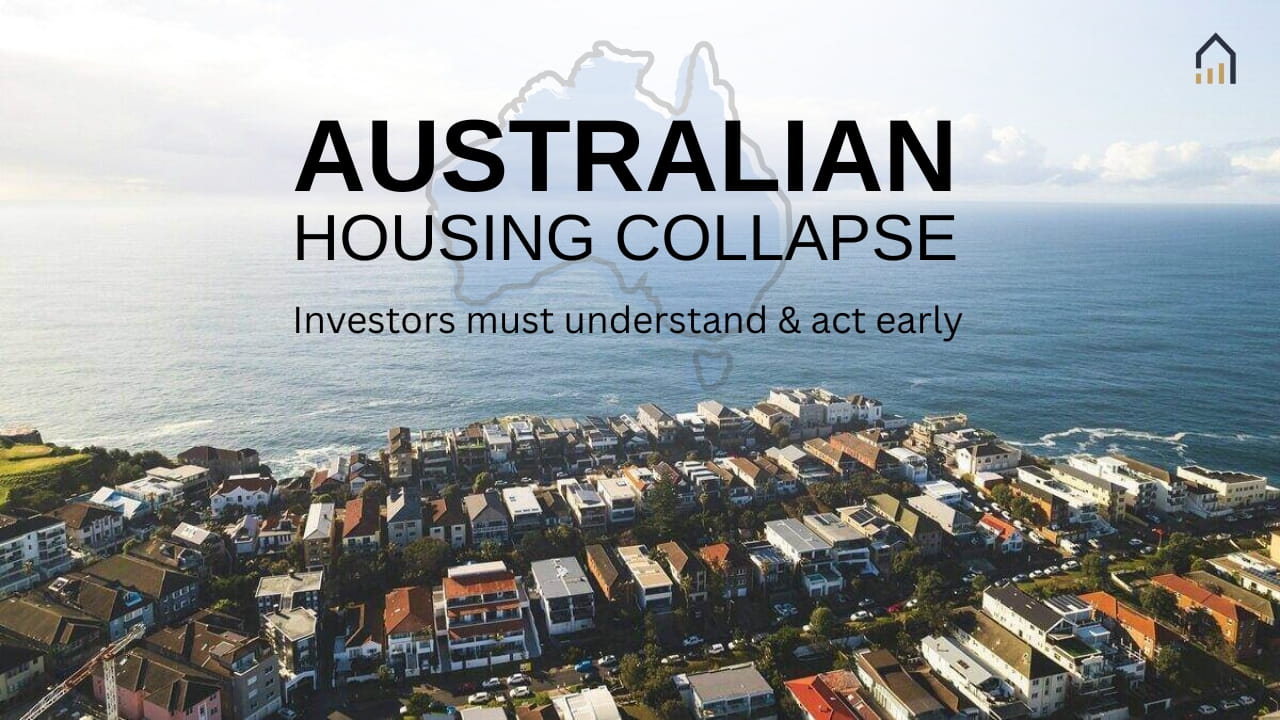
Australia’s Housing Collapse Now Far WORSE Than Expected
Top 5 Highlights
- This is not a crash it is a reset. Property markets are shifting apart, not falling apart.
- Money supply matters more than interest rates. Liquidity continues to drive asset prices.
- Regional markets are on the rise. Affordability and migration are reshaping demand.
- Construction costs are keeping prices from falling. Limited supply will support future growth.
- Growth will vary. Certain cities and suburbs will surge while others remain stagnant.
Why Didn’t Australian House Prices Crash?
Between 2022 and 2023, Australia went through one of the fastest rate hikes in history, with rates rising 13 times. Logically, many predicted a sharp drop in housing prices. Still, that drop never happened.
Property markets are not shaped by just interest rates. They are impacted by a blend of money supply, population growth, supply constraints, and investor behaviour.
What we are observing now is not a crash it is a market reset. In every property cycle, there are periods where growth drops, capital rotates, and new opportunities arise.
The fear in today’s market is mostly fueled by headlines. But history tells us that when you take a step back and analyse the data, a different perspective appears.
The Australian housing market is not crashing. Instead, we are witnessing:
- A shift in where growth is happening
- A shift in where demand is going
- A shift from uniform growth to selective performance
This invites both risk and opportunity. It all depends on how well you understand the cycle.
Bank Predictions: CBA vs Westpac
Australia’s leading banks have released their forecasts, and while they generally agree on moderate growth, there are key differences.
CBA forecasts (2026):
- Sydney: ~2%
- Melbourne: weaker than Sydney
- Brisbane: ~12%
- Perth: ~15%
- Adelaide: ~9%
- Hobart: ~5%
- Darwin: ~4%
Westpac forecasts:
- Sydney: ~3%
- Melbourne: ~4%
- Brisbane: ~7%
- Perth: ~8%
- Adelaide: ~6%
- Hobart: ~3%
- National average: ~5%
What This Means
Both banks agree on one thing: growth will persist but unevenly.
However, the real insight lies deeper:
- Brisbane, Perth, and Adelaide are expected to outperform
- Sydney and Melbourne are likely to experience slower growth
- Attention is shifting to regional and budget friendly markets
The takeaway is simple:
There is no “Australian property market” there are multiple markets shifting at different speeds.
Sydney Affordability & Migration Trends
Sydney is experiencing one of its biggest structural challenges: affordability.
A large part of the city is now regarded as unaffordable for average households, with housing costs surpassing sustainable income levels.
The Migration Shift
Tens of thousands are leaving Sydney for other regions of the country. While overseas migration continues to increase population, domestic migration is moving outward.
Younger buyers, primarily those under the age of 35, are no longer able to enter the Sydney market easily. As a result:
- Many are moving to Brisbane, Perth, and regional areas
- Demand is shifting toward more budget friendly locations
- Lifestyle and flexibility are becoming main decision drivers
Markets Within Markets
Even within Sydney, growth is uneven:
- A few outer and middle ring suburbs still have growth potential
- Premium and highly unaffordable areas are witnessing slower momentum
This reinforces a fundamental concept:
Averages are misleading. Some suburbs will still grow strongly, while others may remain stable or decline.
Interest Rates, Money Supply, and Property
The majority of people focus on interest rates when predicting property prices. However, it is the money supply that drives the market most.
Between 2020 and 2022, Australia pumped around $1.2 trillion into the economy through stimulus and monetary policy. This significantly boosted liquidity.
In recent years as well, money supply has continued to grow.
Why This Matters
When there is more money in the system:
- Asset prices tend to increase
- Investors continue to deploy capital
- Wealthier households continue to maintain purchasing power
Even though some borrowers are under pressure, there is still enough liquidity in the system to sustain demand.
This explains why:
- Property prices did not crash despite rate increases
- Inflation remained high
- Asset markets demonstrated resilience
Key Insight
- Interest rates impact borrowing capacity
- Money supply impacts asset prices
Understanding this distinction is important for investors.
History of Oil Shocks & Property Values
To understand the future, we must look at history.
During the 1970s oil shocks:
- Inflation went up
- Interest rates increased sharply
- Uncertainty rose in the economy
By today’s standards, situations were far worse.
What Happened to Property?
Instead of crashing:
- Property prices went up dramatically
- House prices in Sydney doubled in a few years
- Main cities experienced rapid growth despite economic challenges
This pattern repeated in later crises:
- During the Global Financial Crisis, property remained steady
- After COVID uncertainty, property markets went up
The Core Principle
Inflation typically flows into hard assets like real estate. Even in challenging economic conditions, property typically performs well in the long term.
Regional vs Capital City Property
One of the major shifts happening right now is the movement from capital cities to regional areas.
Why Regional Markets Are Rising
- Lifestyle appeal
- Attractive living
- Quality living
- Appealing lifestyle
- Livable lifestyle
- Desirable living
At the same time, capital cities like Sydney are experiencing:
- Price limitations
- Slower growth
- Outward migration
Structural Shift
This is not merely a short term trend. It shows a longer term change in how people choose where to move and live.
We are moving toward:
- Decentralised population growth
- Increased demand in regional areas
- Capital city growth varies
In the next ten years, we may see affordable, high demand regional markets outperform expensive metro areas.
Construction Costs, Supply, and the Next Boom
One of the most ignored factors in today’s market is construction cost.
Since COVID:
- Building costs have gone up dramatically
- Materials and labour shortages continue
- Development feasibility has decreased
What This Means
When construction costs rise:
- Fewer new properties are constructed
- Supply is limited
- Prices of existing properties become more expensive
At the same time:
- Population growth continues
- Strong demand persists
- Money supply continues to expand
The Result: A Supply Crunch
This creates a powerful dynamic:
- Rise in demand
- Limited supply
- Increase in replacement costs
This momentum has historically led to property booms.
The Hidden Floor
Construction costs keep property prices from dropping. Even if growth slows, there is less chance that prices will fall significantly below replacement cost in the long term.
Takeaway
Australia’s housing market is not crashing it is evolving.
- Australia is in a reset phase, not a crash
- Growth won’t be the same everywhere
- Money supply and limited supply are supporting property prices
- Regional and affordable markets are picking up speed
- The cost of construction is limiting future supply
For investors, the message is clear:
The biggest opportunities will not be where everybody is looking. Investors who understand the shift and act early, positioning themselves ahead of the next cycle, will capture the opportunities.